


Reflections
Free, and Worth Every Penny: Remembering OC Weekly
by Anthony Pignataro

After just a few minutes of turning pages, I realized that the tips of my latex gloves were already black. The paper was old, but the tabloid sheets still seemed crisp, as though I’d just pulled the issue from the rack that morning.
I was reading OC Weekly, the beloved local news rag that would have turned 30 last Sept. 15 had its owner not tired of the place and shut it down the day before Thanksgiving in 2019. It’s early November, and I’m gingerly glancing through it and many of the issues that followed it in a cozy reading room tucked away on the third floor of the Cal State Fullerton’s Pollak Library, handling it like it’s a rare document. And maybe it is, given that I’m searching for a needle of history that I suspect lies hidden somewhere in this newsprint haystack.
Finally, in Vol 1, #49 (Aug. 16-22, 1996), I find it — a single sentence from a brilliant 23-year-old writer named Rebecca Schoenkopf, whose “Commie Girl” column in the Weekly made her one of the most famous journalists in Orange County and who would eventually run the left-wing website Wonkette. Buried in a sprawling story on the Weekly staff visiting the 1996 Republican National Convention in San Diego is a simple sentence with none of the sarcastic fury that would eventually make “Commie Girl” a must-read but that still left me utterly cold:
“Representative Robert K. Dornan is respected by Republicans nationwide.”
I leaned back. These nine words, written 30 years ago in a newspaper that no longer exists, explain so much of what’s happened on the national political stage in the last decade.
The birth of the Weekly coincided with my own start as a professional journalist, which began on Jan. 16, 1996. My first story, which ran about a month later, concerned the destruction of a large sculpture of a deer that had been placed at the construction site of the 73 toll road by activists who hated the project. The piece, which centered local residents instead of official agencies, would exemplify the Weekly’s people-first approach to covering local news and also provide the template for some of the best journalism I’d go on to write over the next three decades.
It all seems so quaint now. Having recently moved back to Southern California after graduating from UC Santa Barbara, I had no idea the Weekly was only a couple months old when I mailed the managing editor a resume and a few copies of essays I wrote in college. I had thumbed through a copy of the Weekly at a Barnes & Noble and noticed that interns had bylines. Though I hadn’t reported news stories since high school, I wanted to write about government and power.
During my senior year at UCSB, I genuinely had no idea what to do with my new BA in political science, until I saw Mike Wallace say in an TV interview that budding journalists shouldn’t bother with journalism school because the nuts and bolts of reporting could easily be taught in the newsroom, but backgrounds in poli sci or history were valuable because it meant the new reporter already understood the systems and processes that make government function.
The investigative journalist Nick Schou, who was just a couple years out of college himself and who would later become the paper’s fourth Editor, interviewed me. I must have said something right because the next week he set me up at the desk next to him (it actually belonged to writer Rose Apodoca, but she was rarely in the office and she said it was fine if I sat there when she was out). I had access to a phone, a stack of phone books and a computer, but if I’m remembering right it wasn’t yet hooked up to the Internet or a content management system so it was basically just a typewriter hooked up to what Founding Editor Will Swaim called the paper’s “sneakernet.”
Writers typed up stories in a news folder on the server, and then after he approved the draft he’d write the name on a little sticky note and walk it over to the copy editing desk, which when I started was the home of Patty Marsters, and then she would proof the story, print it for fact-checking and then move it to production.
At the Weekly, Marsters was the pin that kept the grenade from exploding. One of only two people who was with the paper through all 24 years of its existence (the other was theater critic Joel Beers), Marsters generally stayed behind the scenes throughout the Weekly’s run, eventually rising to Managing Editor. Without her eye for detail and conscientious nature, I can’t imagine the Weekly lasting as long as it did.
In the days before the bottomless flood of “content” that powers social media and “influencers,” the Weekly generated publicity in its first year by being outrageous. A close cousin of LA Weekly, OC Weekly’s then owners at Hartz Mountain Corp. simply let us do what we needed to do to build alternative news coverage in the county. Funded entirely by advertisements that included Big Tobacco, the Irvine Company’s apartment communities, local clubs and restaurants and “massage” girls, issues of OC Weekly were deposited at racks across the county, centered on entire segments of the economy that either no longer exist or are shells of the former selves: Tower Records, Sam Goody, Borders and Barnes & Noble, most notably.

All of this flooded my memories as I sat near a drawing of Cesar Chavez in the cramped third floor office of the Cal State Fullerton University Archives & Special Collections Reading Room. Former Weekly Editor (and current Los Angeles Times columnist) Gustavo Arellano had recently donated his complete archive of about 1,200 Weekly issues to the college, along with other documents related to the paper, and I wanted to see them. Not just to reminisce about the earliest steps I took in journalism, but to also confirm a theory that had lately been floating in my head that a lot of the work we did that first year or so predicted both the right-wing extremist evolution of the national Republican Party and the most effective ways to counter it.
“[O]ur chief order of business is to try desperately not to be boring,” Jim Washburn, a former LA Times reporter, wrote in his “Lost in OC” column in the Weekly’s premier issue. “We’d like to praise the good and administer Indian burns to the wicked. We’d like to present alternatives. And if we can also be your source for those hot 900-line ads, so be it.”
The Weekly was many things that first year or two, but it was never boring. And it never talked down to readers.
When then-Orange County Register Reporter John Hughes mailed staffer R. Scott Moxley a letter calling him a “jizzbag” and wishing “that you and all of whom you fake a microfiber of pathos develop cancerous polyps and die in slobbering froth” (Moxley had previously criticized the reporter’s work, noting that he had repeated negative stereotypes of gay people without context or criticism), Moxley not only reprinted excerpts of the letter, but also called Register Editor Tonnie Katz — who immediately derided Moxley as “juvenile and unprofessional” — and Hughes himself, then published an excerpt of that conversation as well (it included numerous vulgarities but also Hughes saying “I have no remorse for anything I said in that letter”).
When then-LA Times OC bureau Editor Marty Baron (who later went on to edit the Washington Post and Boston Globe(Liev Schreiber played him in the 2015 movie Spotlight) wrote us an angry letter about a long, deeply reported piece on how the Times and Register had failed their readership by not reporting the many warning signs leading to the infamous 1994 Orange County bankruptcy, OC Weekly Editor Will Swaim ran the letter, along with his withering, sarcastic response.
And when a 37-year-old woman won a $1.3 million sexual harassment judgment from Bible-thumping OC Assemblymember Mickey Conroy (she had been his secretary, and told the Sacramento jury that he had subjected her to unwanted hugging, kissing, touching and crude sexual inuendo), the Weekly not only wrote a brief story on the matter, but then Swaim and Art Director Heather Anderson (who were then dating and later got married) posed for a series of ultra-cringey “reenactment” photos as part of a full-page “idiot’s guide to beat the sexual harassment rap.”
Best of all, after the Weekly started running ads for a local company that taught men to exercise by swinging weights from their penis (it was popular at the time, I guess), Washburn volunteered to undergo the practice and then write about it.
Washburn was one of the finest writers I’ve ever worked with. I can’t imagine he’s ever written a bad sentence. Thoughtful but acerbic, his columns each week were a masterclass in writing, informing and inspiring readers on everything from a national election to an acorn pit that hit him on the head one morning. I somehow beat out Washburn to win the Orange County Press Club’s Best Profile of 2019 award, an accomplishment I consider the pinnacle of my career.
And he was just one of a half-dozen writers I was now learning from. In my first few months, in addition to Washburn, Apodaca, Schoenkopf and Schou, there were Matt Coker and Tom Vasich, the calendar editor and production editor, respectively. Both were newsroom veterans, but neither seemed like your stereotypical Woodward and/or Bernstein. Coker could write any story you wanted and still make it hilarious, while Vasich gave us marvelously descriptive food stories each week (which, at least early on, ran without photos, incredibly).

Later I got to know Steve Lowery and Dave Wielenga, who had worked at the Long Beach Press-Telegram. Both were exemplary reporters who wrote vivid feature stories seemingly without effort.
And yes, that’s a lot of white guys. I can remember Washburn poking fun at it even back then, but it would be years before the Weekly’s masthead started reflecting the county as a whole.
Though I think he genuinely wanted to cover as much of the county as possible, racial equity was never a pressing deal to the guy sitting atop the masthead. Swaim’s simple “Editor” title masked almost complete authority over the paper. No story, at least in the first few years, escaped his editing, which often resembled straight-up re-writing. And not solely for a cub like me, either — I recall poking my head in Swaim’s office and seeing Schou and even Moxley sweating out line-by-line story edits that could drag on for hours. But then again, Swaim was one of the few authentic geniuses I’ve met in life, and he seemed to sharpen sentences into wonderful linguistic blades for fun.
That said, his ideology was slippery, at best. “My politics are weird,” Swaim told me early on in my internship. “They’re kind of leftist-libertarian.” While he definitely presided over a left-wing staff and many brilliant, leftist stories back then, today he’s the CEO of the California Policy Center, a non-profit based in Tustin that’s dedicated to, in its words, “eliminating public-sector barriers to freedom,” which is about as anti-leftist as you can get.
In all, imagine working with every class clown you knew. The Weekly back then was a room full of the smart kids who always sat in the back row in school, cracking jokes and making you laugh at the worst times, but then always acing tests, too. Thursday staff meetings were joys for me — hilarious gatherings where we first critiqued the issue that was just published and then talked about what we were working on for the following week. If you could get the staff — or even just Swaim — to laugh, then you were doing well.
But the writer I learned the most from was Moxley.
From 1996 to 2019 – virtually the entire run of the Weekly — Moxley was a terror in Orange County. While the rest of us were making readers laugh here and there and maybe getting some backbencher councilmember in trouble, the law enforcement officers and Republican Party bosses who ran the county were trembling at the mere sight of Moxley’s byline. And no one in power was safe.
In 2002, CNN’s Larry King dubbed Orange County Sheriff Mike Carona, one of the most powerful lawmen in the country, “America’s Sheriff,” after his deputies quickly captured the man who murdered five-year-old Samantha Runyon. Seven years later, as a direct result of Moxley’s relentless reporting, a federal jury convicted “America’s Sheriff” of witness tampering, a serious crime for anyone, let alone the top cop in OC. Carona was later sentenced to 66 months in prison.
Moxley was the best investigative reporter I’ve ever known, but his stories did more than surprise or impress you. The first story I ever read from him, titled “Kill a gay man and go free,” ran in the Weekly’s Feb. 2, 1996 issue. The story filled me with an unutterable rage that I’ve never really lost. In page after page, Moxley described how Scott Andrew Stockwell had brutally killed Boyd W. Finkel, simply because he was worried Finkel was trying to turn him gay.
“Irvine Police Detective Larry Montgomery said Finkel had been sitting on his living room couch reading the Sunday funnies when the killer approached from behind and began swinging,” Moxley wrote. “The attack’s ferocity splattered blood as far as the dining room wall, some 15 feet away… Police later learned the killer stayed for hours after the attack, drinking beer, showering and searching the house before stealing Finkel’s Honda Prelude.”
But the real power of Moxley’s story came not just from police testimony on the violence of the crime, but from the jurors who found Stockwell guilty of mere involuntary manslaughter (his sentence ended up being time served plus 54 days). Even worse, more than a few jurors had actually sympathized with Stockwell’s insistence that Finkel was the true monster.
“One juror, a housewife clutching a copy of Chicken Soup for the Soul to her chest, said the majority decided it was okay to defend oneself against homosexual advances by ‘whatever means necessary,’” Moxley wrote. “Stockwell ‘suffered enough,’ said another juror, who later wrote to Judge James K. Turner asking for leniency. ‘I learned more about homosexuality than I cared to,’ she said. ‘Finkel was a pervert.’ When asked about the brutality of the killing and Stockwell’s inconsistencies, she responded, ‘So what?’”
The vast majority of all news stories everywhere are extremely valuable the day they appear, but pretty much worthless a day or two later. But the work writers like Moxley and Washburn and Schoenkopf were doing at OC Weekly was different. These were articles you wanted to cherish, not just because they had information you couldn’t find elsewhere, but because they were full of truth and raw human feeling that was sometimes terrible but other times, in its own way, quite beautiful.
In the early years, Moxley’s greatest achievement lay in his coverage of Rep. Bob Dornan. While many Weekly staffers contributed to the paper’s campaign to get readers to see Dornan as an immigrant-hating and gay-bashing freak, Moxley was responsible for the paper’s biggest scoops, which in turn made him Dornan’s most hated target.
A former actor and Air Force fighter pilot (he never fought in combat, but did crash three planes in training), Dornan got himself elected to Congress in 1976, representing a Los Angeles-area district. A right-wing blowhard who worshipped military spending (hence his nickname, which he got for his full-throated support of the overpriced nuclear bomber) as much as he bashed gays and lesbians, Dornan eventually set his sights on Orange County. In 1984, he was elected to the congressional seat representing Garden Grove, which he would hold until his defeat in 1996.
Dornan was two things in the 1980s and ‘90s: a clown who went out of his way to say obnoxious insults demonizing gay people, women and immigrants, and a very popular figure with grassroots Republicans, as Schoenkopf had learned during her trip to the 1996 Republican Party Convention. In his Oct. 18. 1996 cover story “The Secret Lives of Bob Dornan,” Moxley laid out exactly how popular Dornan was with rank-and-file Republicans.
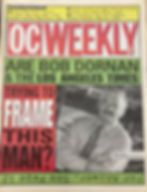
“Twenty years ago, when the average cost of a House campaign was less than $250,000, Dornan was already raising and spending more than $1 million per election,” Moxley wrote. “But most of his money comes in amounts less than $200 from individual contributors. Ninety-seven percent of them live outside Dornan’s district, and two-thirds of them don’t even live in California, according to a 1994 Democratic Party analysis of Dornan’s FEC records. By saying things no one with common sense or good taste would say, he attracts loyal nationwide support from the Right’s wacky fringe. These individual backers are for the most part not wealthy conservative businessmen but include an assortment of religious fundamentalists, sexists, gun nuts, homophobes, military enthusiasts and global-conspiracy theorists–a modern-day diaspora of the John Birch Society.”
Basically, Moxley was describing the “Make America Great Again” folks, two decades before Donald Trump started using the term.
The Weekly had been making fun of Dornan since its birth. “[W]e’re in hell, which at least goes a long way toward explaining why Bob Dornan represents us,” Washburn wrote in the very first OC Weekly issue. Later, he called Dornan a “raving pork loin,” a description I challenge anyone to top.
In December 1995, Coker wrote a satirical “gift guide” that included “B-1 Bob’s Big Boy Bank,” which was literally just a Bob’s Big Boy figure with Dornan’s face superimposed on it. “This collectible looks as old-fashioned and out of touch as the Garden Grove congressman it represents,” Coker wrote in the caption. “But flip a hidden switch, and the figurine electronically spews a maniacal diatribe about Red threats, which ends only if you stuff its mouth full of cash.”
The 46th Congressional district’s changing demographics (fewer whites, more Latinos) ultimately doomed Dornan, but his November 1996 reelection race against Democrat Loretta Sanchez was close. Fewer than a thousand votes close (out of 106,000 cast), which is why Dornan wasted no time throwing around casually racist accusations that “Latinos” had stolen the race from him. Almost immediately, Republicans in Congress, as well as other prominent Republicans like California Secretary of State Bill Jones and Orange County District Attorney Mike Capizzi began investigating both Sanchez’ campaign and Hermandad Mexicana Nacional, a Santa Ana-based immigrant rights organization that Dornan insisted was at the heart of a massive conspiracy that registered thousands of undocumented immigrants to steal the election and drive him from power.
Moxley immediately went to work, and soon reported that Dornan’s allegations were not only comical, but hypocritical. In fact, Moxley soon learned that the same voter fraud accusations Dornan was regularly vomiting out could easily be applied to Republican voters in the 46th District. What’s more, Moxley also determined that Dornan himself hadn’t entirely been honest about where he lived when he filled out a voter registration card (under penalty of perjury!) back in 1984.
“On the form, Dornan — then a resident of Los Angeles who was planning to carpetbag to challenge incumbent Orange County Democratic Congressman Jerry Patterson — falsely claimed that he 1) lived in O.C. and 2) lived in a Buena Park office building,” Moxley wrote in a caption beneath a photo of the voter registration card in question that ran in the Dec. 20, 1996 issue.
But Moxley’s sights soon fell on the LA Times OC bureau itself, and principally, reporter Peter Warren. Were it not for the Times’ willingness to pursue the alleged voter fraud story, the whole matter would have died a quick death in the days after the election. Instead, the shameless travesty of an “investigation” lasted 16 months before finally ending with no indictments and Sanchez officially taking office.
The Times and Dornan were close, Moxley soon determined. In the earliest post-election hours, while votes were still being counted and Dornan was holding a slim 233-vote lead, the Times reported that “O.C. Latinos’ turnout falls short of hopes.” But just a few weeks later, when the lead shifted and Sanchez appeared the winner, the Times began reporting that “Latino power” was responsible for her victory. The bombshell fell on Dec. 27, when the Times reported that 18 undocumented immigrants — assisted by Hermandad and its leader, Nativo Lopez – said they voted in the 46th Congressional District race.
Moxley soon learned that the Times and Dornan were getting their numbers from the same source: the Torrance-based Fair Elections Group. Though the Times behaved as though the organization was non-partisan, it was in factly extremely rightwing, as Moxley showed in a Jan. 17, 1997 story. In fact, the group had connections to a variety of anti-immigrant Republicans who’d been pushing the voter fraud story for years.
One of them was Harold Ezell, who had headed the Immigration and Naturalization Service (INS) during the Reagan Administration. Ezell was both a Dornan partisan and one of the nastiest immigrant bashers in the nation at that time. When he died in 1998, the Weekly paparazzied his funeral, running a photo of his open casket alongside an obituary that could best be described as jubilant.
In the months after the ‘96 election, Dornan and his Republican allies steadily increased the number of “illegal” votes that supposedly tipped the balance to Sanchez, though their evidence was always either slim or non-existent. The Timesreported it all, with little context and no pushback.
“If every vote associated with Hermandad… was tossed out, Dornan would still lose by 465 votes,” Moxley wrote in a Feb. 28, 1997 cover story. Still, the Times continued to push the story, steadfastly refusing to tell its leadership that all this was caused by a raging homophobic egomaniac who couldn’t face his election loss.
The sudden and intensely negative attention on Hermandad quickly got scary, Moxley reported in late February 1997. A month prior, someone had placed a plainly wrapped package in the Hermandad office lobby. The return address was just the name “Santa Ana Citizens Committee,” a chilling nod to Jim Crow white supremacist groups that had spurred so much racist violence decades earlier. A letter attached to the package said, “Congratulations, Nativo Lopez, you’ve joined the Benedict Arnold Club.” The police department’s bomb squad soon determined the package contained no explosives, but it did hold a dead fish — the Mafia’s old way of telling the recipient he’s marked for murder.
At the same time, the pressure of being criticized by the Weekly month after month was getting to the Times leadership. In mid-March 1997, William Nottingham, who’d taken over the Times’ OC bureau from Marty Baron, lashed out at the Weekly on John Earl’s KUCI radio show. When Earl asked Nottingham if the Times had ever investigated the Weekly’s reporting on alleged Republican voter fraud, Nottingham lost it.
“What’s their paid circulation?” Nottingham asked. “What makes you think they’re a major newspaper?” After Earl noted that the paper was, in fact, given away for free throughout the county, Nottingham said, “I think they’re worth every penny of that.”
The remark delighted Swaim — so much so that he put a small picture of Nottingham on the cover of our March 21, 1997 issue with a caption that read “STILL FREE! And ‘worth every penny of it!’”
The investigation dragged on, but even the Republicans in Congress weren’t giving Dornan the victory he wanted. Dornan started calling Swaim – and Swaim’s dad, too, which kind of freaked out the rest of the staff. He also started leaving voicemail messages that included weird John Wayne impersonations on Coker’s phone. Then in April, Dornan convinced investigators to subpoena Moxley, but all that did was give the Weekly a supersized shot of free publicity.
The whole thing was a circus (the Weekly’s attorneys soon got the subpoena quashed, and as I’ve noted, the big voter fraud investigation ultimately amounted to nothing) but I’d argue it was all instrumental to building the Weekly’s brand in those first few years. Yeah, we had curse words in news stories and sex ads in the back pages, but we were also getting recognized for defending community leaders and organizations while taking on the most powerful institutions in the county (Dornan, the Republican Party, the Los Angeles Times).
And we were having a blast doing it.
Eventually, the words “bitter, defeated ex-congressman” began appearing in front of Dornan’s name, which the Weeklydid for years after the election, just to keep reminding readers that the “raving pork loin” was unworthy of respect or attention. Sure, Dornan ran against Sanchez in 1998 in what The New York Times termed a “bitter rematch,” but she won easily. The county was finished with Dornan, and finally, even he got it.
Much of what I’ve just written is based on stories that long ago vanished from the Internet. They exist only in memories now, and in the yellowed copies carefully preserved at Cal State Fullerton.
As of 2021, the average lifespan of a website was two years and seven months, according to Forbes. Four years later, the writer S. E. Smith told NPR that “Pew recently did a study showing that about 40% of websites since about 2013 have just vanished.”
So how long will the college’s acid-free banker boxes and latex glove handling requirements actually preserve the Weekly issues?
Given that the papers are stored away from dust, light and in a space with stable temperatures, they can last “for quite a long time,” said Patrice Prestinary, the college’s Archivist & Special Collections Librarian. The end goal, she told me, will be to make digital copies of every issue “available via our digital repository as soon as possible as a back up to the newsprint.”
The idea that anyone with web access can call up every OC Weekly issue ever published is wonderful to me, but the Luddite in me takes refuge in the fact that paper, properly stored and cared for, can last for centuries. That’s according to the Library of Congress, though officials there did specify that they were talking about “good quality paper,” which, to be fair, was never really anyone’s go-to description of the OC Weekly.

Anthony Pignataro is an editor at Long Beach Watchdog and a freelance journalist. He wrote for OC Weekly in its earliest years, and in its final months. He also somehow wrote three trashy detective novels about Maui and, most recently The B Girls. He lives in Long Beach with his girlfriend Angie and their cat Gromit.